
Bayon Siem Reap Visitor Guide: Plan Your Visit

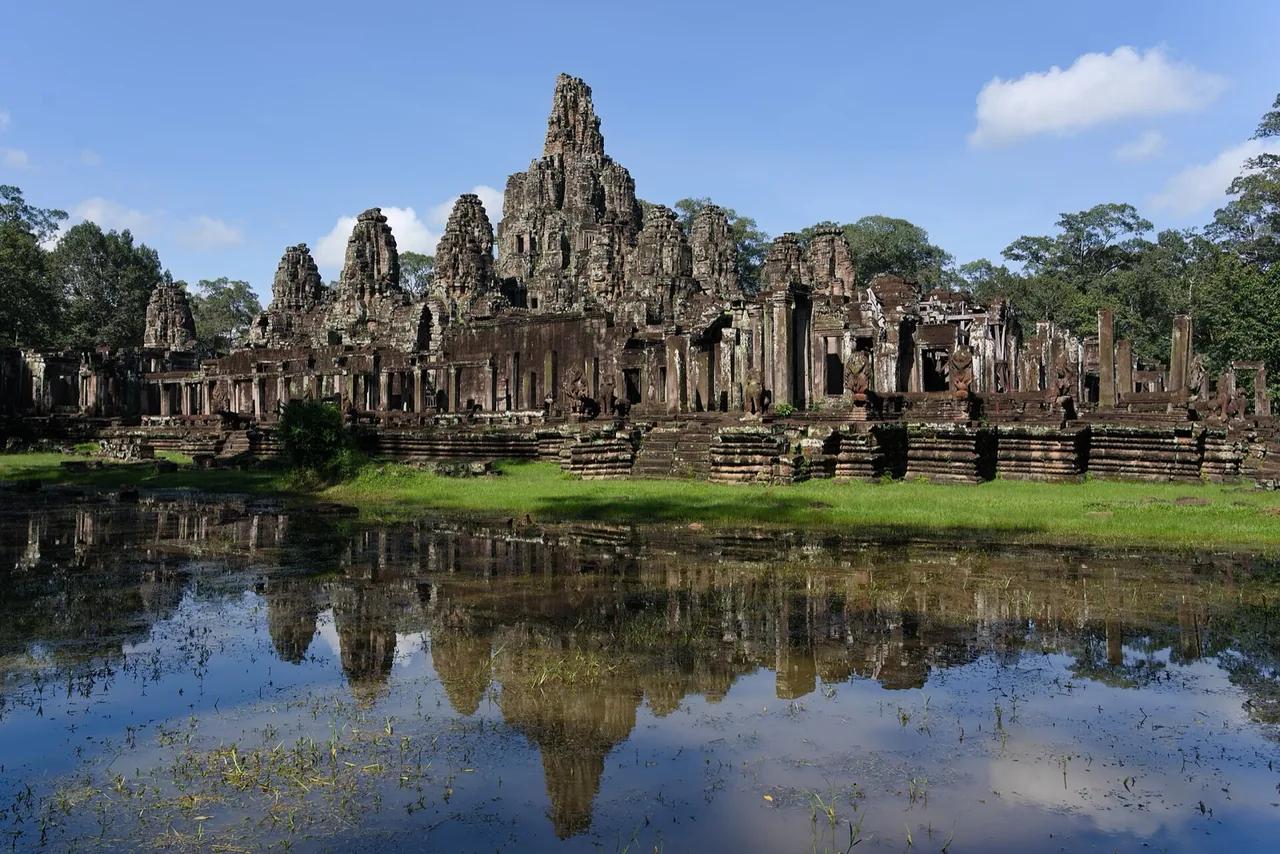
The Bayon is the state temple of King Jayavarman VII, at the center of his capital, Angkor Thom. Instead of one grand tower, it fills its upper terrace with towers carved with serene, smiling stone faces, and surrounds them with two galleries of bas-reliefs that mix battles, daily life and mythology. This guide uses the official hours and Angkor Pass prices from Angkor Enterprise, the park's ticketing body.
Last updated November 2026. Below you will find what the temple is, what it costs, how to reach it, and how to fit it into a day. For wider context, our guide to Siem Reap attractions covers the other major stops.
About the Bayon Temple in Angkor Thom
The Bayon was the last state temple built at Angkor, raised in the late 12th or early 13th century for King Jayavarman VII. It sits at the exact center of his capital, Angkor Thom, and has no wall or moat of its own: it uses those of the city, a city-temple arrangement covering 9 square kilometers. Angkor Thom's walls are 8 meters high, and each runs for 3 km. The temple faces east.
It is the only Angkorian state temple built primarily to worship Buddhist deities. Angkor Enterprise describes it as the state temple of the Mahayana Buddhist King Jayavarman VII, and it was conceived as a Mahayana Buddhist monument. Later rulers altered it, including the Hindu restorationist Jayavarman VIII in the mid-13th century, and it was changed again as Theravada Buddhism spread. Sixteen chapels that once stood in its courtyards were demolished, and in 1933 a 3.6-meter Buddha statue was recovered from a well.
Its original name was Jayagiri; the name Bayon was given by Etienne Aymonier in 1880. The École Française d'Extrême-Orient restored the temple by anastylosis in the early 20th century, and since 1995 the Japanese Government Team for the Safeguarding of Angkor (JSA) has been its main conservation body.
Bayon Opening Hours and Angkor Pass Prices
Angkor Enterprise, the official ticketing body, lists the Bayon as open every day from 7:30 AM to 5:30 PM. Those are the temple's own hours. The Angkor Pass listing gives a wider park-wide window, with park entry from 5:00 AM and closing at 6:30 PM; that window applies to the park and its sunrise and sunset spots, not to the Bayon itself.
There is no separate Bayon ticket: the temple is covered by the Angkor Pass. Angkor Enterprise prices for international visitors are shown below in US dollars.
- 1-Day Angkor Pass
- The 1-day pass costs $37 and expires after one day, covering more than 50 accessible temples.
- 3-Day Angkor Pass
- The 3-day pass costs $62 and is valid within 7 days.
- 7-Day Angkor Pass
- The 7-day pass costs $72 and is valid within 30 days.
- Children Under 12
- Children under 12 are exempt from entrance fees and need no ticket, but may be asked to show a passport as proof of age.
A 1-day ticket needs no photo; 3-day and 7-day tickets require a photo for identification. Angkor Enterprise's FAQ also notes that buying a next-day ticket after 4:45 PM allows sunset entry the evening before.

Getting to the Bayon From Siem Reap
Start with the ticket, because you cannot enter without the pass. The Angkor Ticket Office (Angkor Enterprise) is on Road 60, 4 km from Siem Reap's center. Angkor Enterprise also sells passes on its website, through its mobile app, at kiosks, and through tour guides. Stick to these official channels rather than third-party resellers.
The Bayon stands at the exact center of Angkor Thom, and roads lead to it directly from the city gates at each cardinal point. The south gate of Angkor Thom is 7.2 km (4.5 mi) north of Siem Reap and 1.7 km (1.1 mi) north of the entrance to Angkor Wat, so the Bayon fits easily after a stop there.
Angkor Enterprise's FAQ says it is possible to rent and drive a scooter to visit the temples. Otherwise, a tour guide or a hired driver can take you between the temples; agree the route and the price before you set off.
What to See Inside the Bayon
Most visitors come for the faces, yet the galleries below reward a slower look: the outer gallery records everyday Khmer life alongside its battle scenes, and the inner gallery turns to Hindu mythology.
- Face Towers on the Upper Terrace
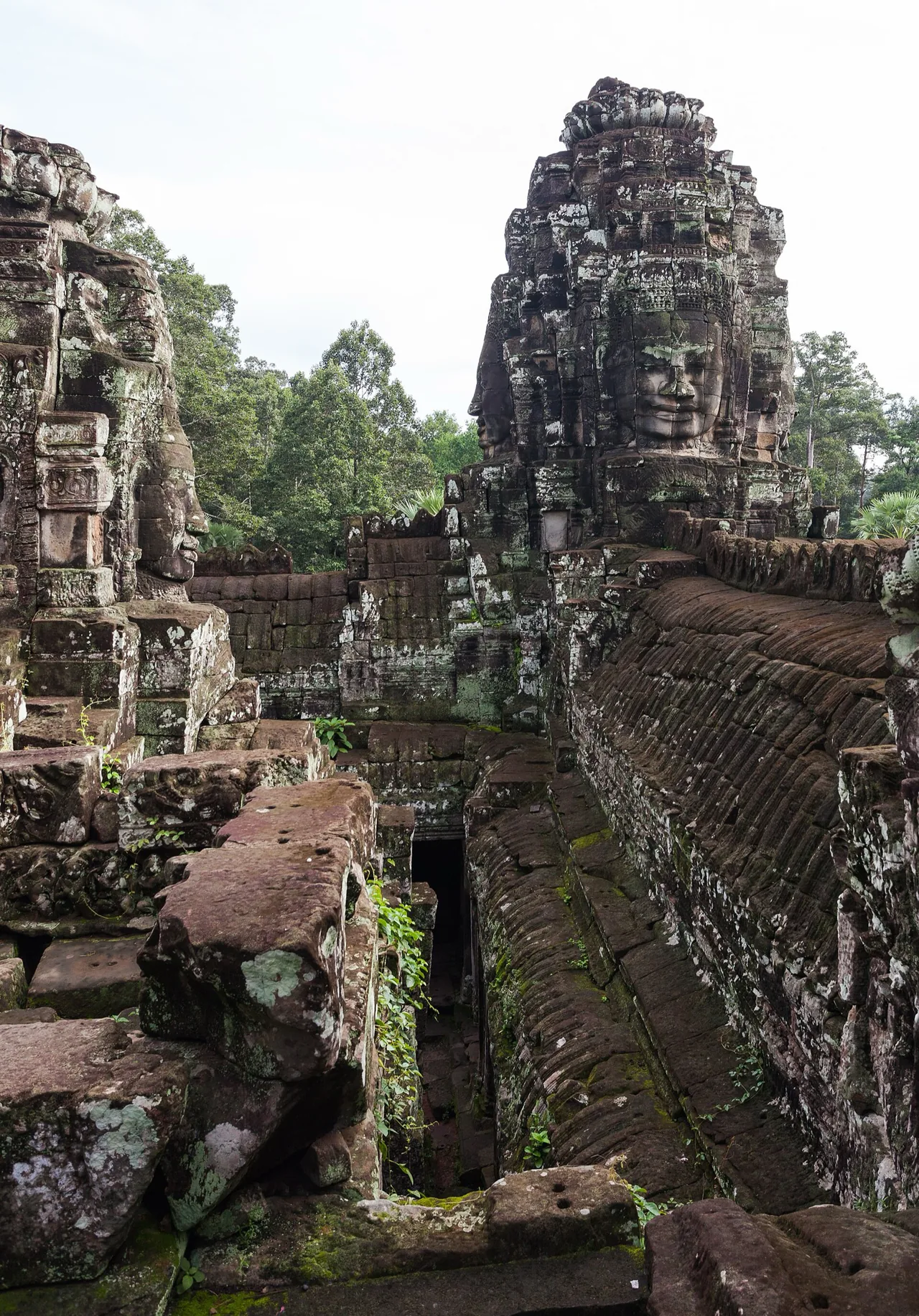
- The temple once had 49 towers, and 37 remain, each carved with two, three, or most often four faces.
- There are about 200 faces, though some are only partly preserved, so there is no definitive count (a figure of 216 is also cited).
- Outer Gallery Bas-Reliefs
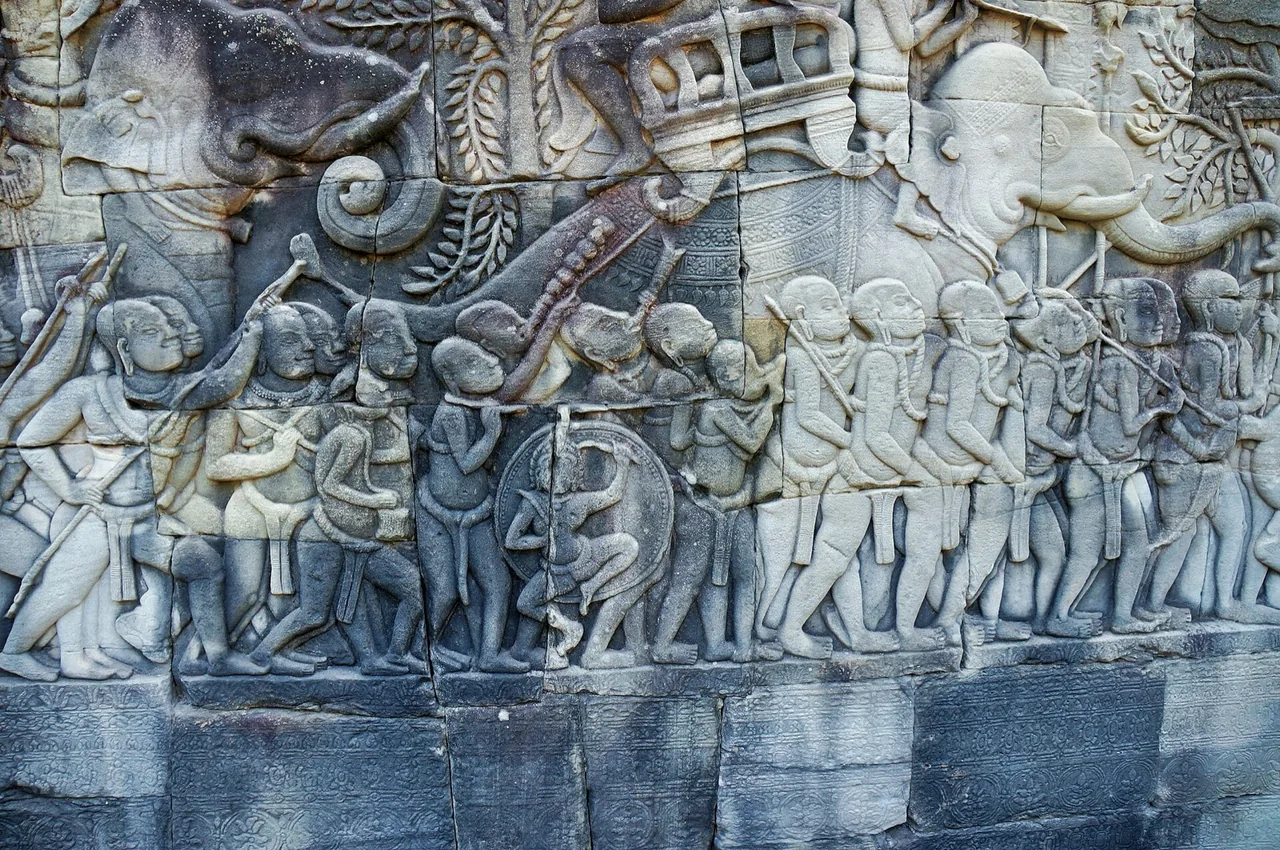
- These carvings show historical events and everyday life: marching Khmer armies, a naval battle on the Tonle Sap between Khmer and Cham forces, a market, open-air cooking and a cockfight.
- Inner Gallery Reliefs
- Added under Jayavarman VIII, this level mostly shows Hindu mythology, including the Churning of the Sea of Milk.
- Central Tower
- The central tower rises 43 meters at the heart of the upper terrace.

Planning a Smooth Bayon Visit
The Bayon's own listed hours, 7:30 AM to 5:30 PM, are narrower than the park's 5:00 AM to 6:30 PM window. If you enter the park at 5:00 AM, the Bayon will not yet be open, so schedule it after other stops and finish before 5:30 PM.
The Bayon is on the Small Circuit Tour that Angkor Enterprise lists for a 1-day pass, together with Angkor Wat, Phnom Bakheng, Ta Prohm, Ta Keo, Banteay Kdei and Srah Srang among others. Our Ta Prohm visitor guide covers another stop on that circuit.
The upper terrace with its face towers and the two galleries of bas-reliefs are distinct parts of the visit, so give both time rather than heading straight for the towers. With a 3-day or 7-day pass you can come back on another day.
Pairing the Bayon With Nearby Temples
Because the Bayon sits at the center of Angkor Thom, it is easy to combine with other temples in the park. Preah Khan is another Angkor temple, and our Preah Khan guide has the details.
For a longer trip, Banteay Srei lies roughly 25 to 30 km northeast of Siem Reap. Temple access there generally runs 6:30 AM to 4:30 PM, and a satellite Angkor Pass ticket counter near its entrance lets visitors buy tickets there if they visit Banteay Srei first. That counter accepts cash in US dollars and major credit cards, including Visa, Mastercard, Discover, Union Pay, JCB and Diners Club. Our Banteay Srei guide covers what to expect there.
Frequently Asked Questions
What are the Bayon temple's opening hours?
Angkor Enterprise, the official ticketing body, lists the Bayon open from 7:30 AM to 5:30 PM. The wider Angkor Temples Park pass lists park entry from 5:00 AM and closing at 6:30 PM, but the Bayon's own listed hours are 7:30 AM to 5:30 PM.
Do I need a ticket to visit the Bayon?
Yes. There is no separate Bayon ticket; the temple is covered by the Angkor Pass. Official prices for international visitors are $37 for a 1-day pass, $62 for a 3-day pass (valid within 7 days) and $72 for a 7-day pass (valid within 30 days). Children under 12 do not need a ticket but may be asked for a passport as proof of age.
Is the Bayon included in a 1-day Angkor Pass?
Yes. Angkor Enterprise's FAQ lists the Bayon on the Small Circuit Tour that a 1-day pass covers, together with Angkor Wat, Phnom Bakheng, Ta Prohm, Ta Keo, Banteay Kdei and Srah Srang among others.
Where do I buy the Angkor Pass?
Angkor Enterprise says passes can be bought on its website, mobile app, at a kiosk, at the ticket counter or through your tour guide. The Angkor Ticket Office is on Road 60, 4 km from Siem Reap's center. A 1-day ticket needs no photo; 3-day and 7-day tickets require a photo for identification.
Who built the Bayon and when?
The Bayon was built in the late 12th or early 13th century as the state temple of King Jayavarman VII, at the centre of his capital Angkor Thom. Later kings, including the Hindu restorationist Jayavarman VIII, modified it.
How many faces are there at the Bayon?
There are about 200 faces on the Bayon's towers, though some are only partly preserved, so there is no definitive count (Wikipedia also cites a figure of 216). The temple once had 49 face towers; 37 remain today.
What do the Bayon's bas-reliefs show?
The outer gallery shows historical events and everyday life, including marching Khmer armies, a naval battle on the Tonle Sap between Khmer and Cham forces, a market, open-air cooking and a cockfight. The inner gallery, added under Jayavarman VIII, mostly shows scenes from Hindu mythology, including the Churning of the Sea of Milk.
How far is the Bayon from Angkor Wat and Siem Reap?
The Bayon stands at the centre of Angkor Thom. The south gate of Angkor Thom is 1.7 km (1.1 mi) north of the entrance to Angkor Wat and 7.2 km (4.5 mi) north of Siem Reap.
The Bayon rewards visitors who arrive with a plan, starting with the Angkor Pass. Keep to the temple's own 7:30 AM to 5:30 PM hours rather than the park's wider window, and give the galleries as much attention as the faces. Pair it with nearby temples, then build the rest of your days around the other Angkor stops.
Planning more of Siem Reap? See our guides to things to do in Siem Reap, the main Angkor temples and the Angkor Pass.