
Preah Khan, Angkor: Tickets, Opening Hours and History

Preah Khan is a 12th-century Buddhist temple in the Angkor Archaeological Park. King Jayavarman VII built it to honor his father, and, like nearby Ta Prohm, it has been left largely unrestored, with large trees growing among its galleries. Entry is covered by the Angkor Pass, and Angkor Enterprise lists the temple as open from 7:00 AM to 6:30 PM.
Last updated November 2026. Banyan Bound Editorial prepared this guide from the official Angkor Enterprise listing and published historical records. Below you will find tickets and hours, the story behind the site, how to get there, what to look for inside and answers to common questions.
Preah Khan Tickets and Opening Hours
Preah Khan sits northeast of Angkor Thom, just west of the Jayatataka baray, the reservoir with Neak Pean at its center. Its name means "Royal Sword" in Khmer, and its original name was Nagara Jayasri, or "holy city of victory." This is the Preah Khan at Angkor, not Preah Khan of Kampong Svay, a different and remote temple in Preah Vihear province.
There is no separate ticket for the temple, because it lies inside the Angkor Archaeological Park and is covered by the Angkor Pass. Angkor Enterprise, the official ticketing authority, gives Preah Khan an opening time of 7:00 AM, although it lists 5:00 AM as the entry time for the wider Angkor Temples Park.
- Opening Hours
- Angkor Enterprise lists Preah Khan as open every day from 7:00 AM to 6:30 PM.
- Other travel sites quote different hours, so check the Angkor Enterprise page close to your visit.
- Angkor Pass Prices
- A one-day pass costs $37, valid for that single day.
- A three-day pass costs $62 and must be used within 7 days of purchase.
- A seven-day pass costs $72 and stays valid for 30 days after purchase.
- Where to Buy
- Buy the pass online at angkorenterprise.gov.kh or in the official Angkor Pass app (App Store and Google Play).
- According to siemreap.net, the Angkor Ticket Office on Road 60, about 4 km from central Siem Reap, sells passes in person from 5:30 AM to 5:00 PM daily.
- Children
- siemreap.net reports that children under 12 enter free, though staff may ask for a passport as proof of age.
History of Preah Khan: A City, Temple and University
Jayavarman VII built Preah Khan on the site of his victory over the invading Chams, and its original name, Nagara Jayasri, "holy city of victory," refers to that win. The foundation stele records that the main image, the bodhisattva Avalokitesvara in the form of the king's father, was dedicated in 1191.
The same stele describes an institution far larger than a single temple. It lists 430 other deities with shrines here and 97,840 attendants and servants, including 1,000 dancers and 1,000 teachers.
That scale makes sense once you see the site as part city, part temple and part Buddhist university. The king's mother was honored in the same way at Ta Prohm, so the two temples form a pair: one for his father, one for his mother.
Modern conservation shaped what you see today. The temple was cleared in 1927-1932 and partly rebuilt by anastylosis in 1939. The World Monuments Fund has maintained it since 1991 and has kept its work to stabilization, so the ruin keeps its overgrown character.

Getting to Preah Khan and Pairing Other Temples
Preah Khan lies inside the Angkor Archaeological Park, northeast of Angkor Thom and just west of the Jayatataka baray. You need an Angkor Pass before you enter the park. Buy it online through Angkor Enterprise or in the Angkor Pass app, or, according to siemreap.net, in person at the Angkor Ticket Office on Road 60, about 4 km from central Siem Reap.
From Siem Reap, you can reach the temple by tuk-tuk, car or bicycle through the park. The main entrance faces east, and there are other entrances at each cardinal point, each reached by a causeway over the moat. If you hire a driver, agree in advance which gate you will leave from so you do not have to walk back the way you came.
Because Preah Khan sits beside the Jayatataka baray, it combines easily with Neak Pean, the shrine at the center of the reservoir. Angkor Thom lies to the southwest, so the temple also fits a day that includes the Bayon in Angkor Thom.
With a multi-day pass you can spread the park over several days, adding Angkor Wat on one day and Banteay Srei on another.
Is Preah Khan Worth Visiting? Who Should Go
Preah Khan suits travelers who want atmosphere and architecture rather than a single famous photograph. Like Ta Prohm, it has been left largely unrestored, with trees growing among its galleries.
The two temples are closely linked: Jayavarman VII built both, Ta Prohm to honor his mother and Preah Khan to honor his father. Preah Khan adds features of its own, including a Hall of Dancers and a two-storey building with round columns found nowhere else at Angkor.
Choose Preah Khan if you enjoy long corridors, carved details and a sense of exploring. Skip it only if your pass is limited to one day and you want to spend every hour on Angkor Wat.
- Timing Your Visit
- Angkor Enterprise lists the temple as open from 7:00 AM to 6:30 PM, so you can plan either a morning or an afternoon visit.
- Carry water and wear comfortable shoes, since the site involves a lot of walking over uneven stone.
- Dealing With Crowds
- If a tour group arrives while you are in a gallery, take a side corridor and let it pass.
- Best Pass Choice
- The $37 one-day pass covers Preah Khan along with the rest of the Angkor Archaeological Park for that day.
- The $62 three-day pass, used within 7 days, lets you split the park into slower, shorter days.

Walking the Long Axis and Key Features
The moated laterite outer wall measures 800 by 700 meters and encloses 56 hectares (140 acres). It is decorated with 72 garudas holding nagas, set at 50-meter intervals. The stone temple itself sits within a much smaller third enclosure of 200 by 175 meters.
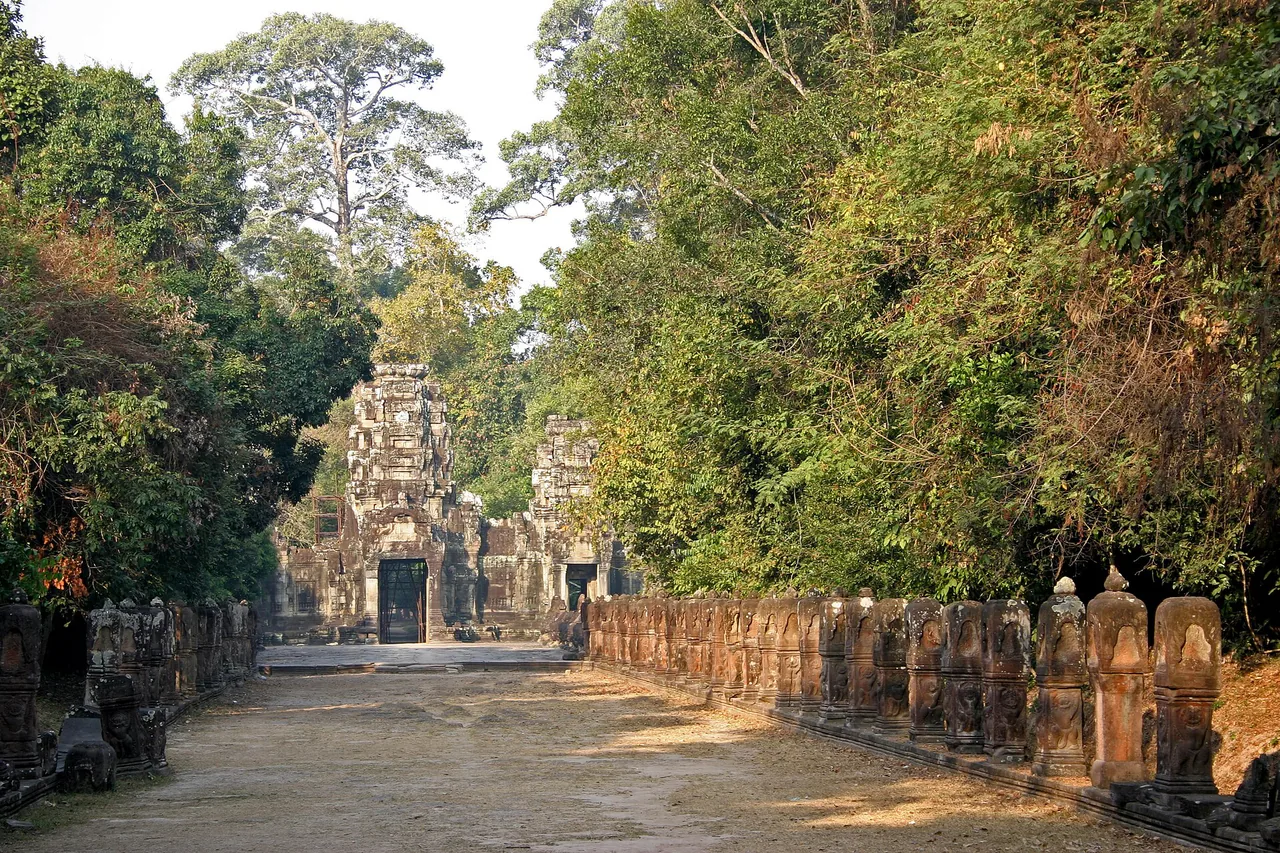
Enter through the main east gate, where the causeway crosses the moat past rows of devas and asuras carrying nagas. From there, head west toward the center of the temple, where a central stupa stands, added centuries after the original construction.
Look for the Hall of Dancers, where apsara carvings decorate the walls. The temple also holds a House of Fire and a two-storey building with round columns found nowhere else at Angkor.
Satellite shrines to Shiva, Vishnu and past kings and queens stand within the complex. Take side corridors when you can, since the quieter galleries are often the most atmospheric.
Reading the Ruins Without a Guide
A guide helps, yet a few simple clues let you read Preah Khan on your own. Remember that restoration here has been kept to stabilization, so much of what you see is the ruin as it was found rather than a rebuilt temple.
Notice the shrines and doorways as you walk, and recall the stele's claim that 430 other deities had shrines here. Most of the 56 hectares inside the outer wall were once a city built of perishable materials and are now forest.
The stone temple is only a small part of the enclosure, which is why the site feels like the heart of a vanished city. Respect posted signs and avoid climbing on unstable walls, since collapsed sections are part of the site's character.
Frequently Asked Questions
Is Preah Khan included in the Angkor Pass?
Yes. Preah Khan is inside the Angkor Archaeological Park and is covered by the Angkor Pass, so there is no separate ticket. Angkor Enterprise sells a 1-day pass for $37.00, a 3-day pass for $62.00 (valid within 7 days) and a 7-day pass for $72.00 (valid within 30 days).
What are Preah Khan's opening hours?
Angkor Enterprise, the official ticketing authority, lists Preah Khan as open from 7:00 AM to 6:30 PM. Angkor Enterprise gives the wider Angkor Temples Park an entry time of 5:00 AM, but the Preah Khan page itself says 7:00 AM.
Where do I buy an Angkor Pass for Preah Khan?
Buy it online at angkorenterprise.gov.kh or in the official Angkor Pass app, or in person at the Angkor Ticket Office on Road 60, about 4 km from central Siem Reap.
Do children need a ticket?
Children under 12 enter free, though staff may ask for a passport as proof of age.
Who built Preah Khan and why?
King Jayavarman VII built Preah Khan in the 12th century to honor his father. Its main image, the bodhisattva Avalokitesvara in the form of the king's father, was dedicated in 1191; the king's mother had been honored the same way at Ta Prohm.
What does the name Preah Khan mean?
Preah Khan means "Royal Sword" or "holy sword". It echoes the temple's original name, Nagara Jayasri, "holy city of victory", because it was built on the site of Jayavarman VII's victory over the Chams.
How big is Preah Khan?
The moated outer wall measures 800 by 700 m and encloses 56 hectares (140 acres). Most of that area was once a city built of perishable materials and is now forest; the stone temple sits within a third enclosure of 200 by 175 m.
Where is Preah Khan located?
Preah Khan lies northeast of Angkor Thom and just west of the Jayatataka baray, the reservoir with Neak Pean at its centre. Its main entrance is on the east side, with other entrances at each cardinal point.
Preah Khan rewards visitors who want long corridors, carved detail and trees woven into stone. With the Angkor Pass in hand and a 7:00 AM to 6:30 PM window, you can choose a morning or an afternoon visit.
For more temples, browse our Siem Reap attractions guide and plan the rest of your temple days. Confirm current hours and prices on the Angkor Enterprise site before you travel.
Planning more of Siem Reap? See our guides to things to do in Siem Reap, the main Angkor temples and the Angkor Pass.